- Material: spring-tempered stainless steel, usually grade 301, with nickel or gold plating where low contact resistance matters.
- Sizes: the dome lines written into 341 industrial keypad projects we have built use four diameters: 6.0mm, 8.4mm, 10mm and 12.2mm. 12.2mm is the most common.
- Force: 160g to 420g across those projects. Every tolerance that was written down was ±30g.
- Shape: four-leg discs dominate; round, triangle and oblong domes suit other contact patterns and key sizes. Triangle domes come in 4mm to 8mm.
- Supply form: loose domes, or a dome array pre-placed on an adhesive retainer sheet. Most retainers in our records are 0.05mm polyester film.
How it works
How does a metal dome work in a membrane switch?
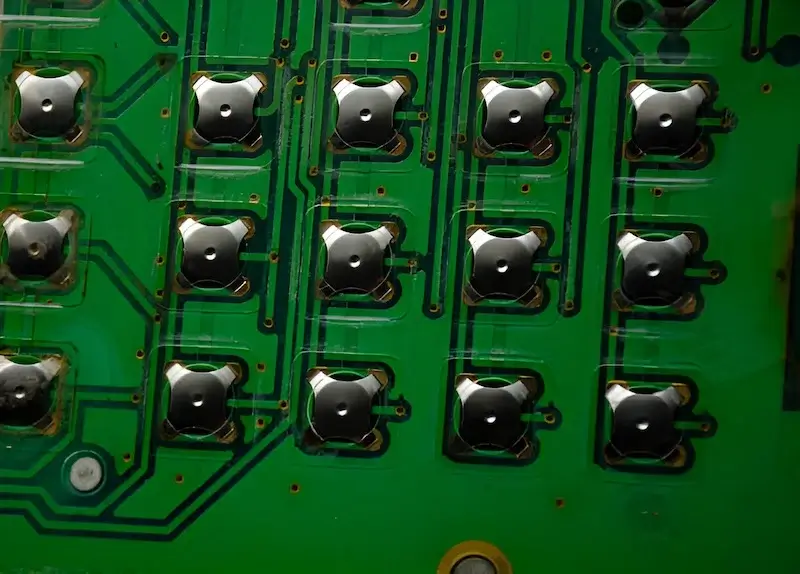
A tactile dome switch, also sold as a snap dome or metal dome, is a stainless steel disc placed over contact pads in a membrane switch or on a PCB. Pressing it collapses the dome with a click and closes the circuit. Releasing it lets the dome spring back, and the contact opens again.
The dome is a shallow stainless steel cup. Pressing the key loads it until it snaps through, the force drops sharply, and the operator feels and often hears the click. At the bottom of the stroke the dome touches the contact pads on the circuit and closes the key.
A poly dome does the same job by forming the bump into a polyester layer. It is quieter and softer, and it needs no separate part. Domes appear in 93 of the 185 layer recipes on our records, and only 3 of those were poly domes. The moulded option is on the poly dome membrane switch page.
Step 1
How do you choose the right metal dome force?
Start from how the key is actually pressed: bare fingertip, gloved hand, or thumb through a sealed overlay. That sets a force band.
| Force | Who it suits | Watch out for |
|---|---|---|
| 100 to 180g | Bare fingertip, frequent input, bedside and desktop equipment | Easier to trigger by accident if keys sit proud of the panel |
| 200 to 280g | General industrial panels, the usual starting point | Heavy gloves start to blur the snap |
| 300 to 450g | Gloved operation, vibration, outdoor and mobile equipment | Tiring if a key is pressed hundreds of times a shift |
| 500g and above | Heavy gloves, guarded functions | Needs a larger dome to stay comfortable |
250g against 400g, in practice: 250g suits a bare finger working the keys all day, 400g suits a glove between finger and overlay or a machine that vibrates. With a bare finger, 400g reads as stiff. Through a work glove, 250g can feel like nothing happened. That is the pair worth putting in front of the people who will use the machine.
Step 2
Why do two domes with the same force feel different?
Snap ratio. It is the share of force that disappears the moment the dome collapses, and it decides how crisp the click feels inside a force band.
Actuation force
The peak force just before the dome collapses. This is the number on the part code.
Snap ratio
The drop from peak to contact force. A higher ratio gives a sharper, louder snap that survives glove padding. Work it out with the snap ratio calculator.
What sits above
Overlay thickness, hard coat and embossing all soften what reaches the finger, so the same dome feels different under a different overlay.
So the last step is always a physical sample. We build a small set to your outline with two or three candidate domes fitted, and your operators press them through the glove they actually wear. The sample route is described on the membrane switch prototyping page.
Project records
Which dome sizes and forces do real projects use?
Four diameters and seven force values cover nearly all of it. These are the dome lines written into 341 industrial keypad projects we have built; 185 carry a full layer recipe and 93 of those name a dome, 90 of them metal.
| Diameter | Forces seen with it | Where it tends to land |
|---|---|---|
| 6.0mm | 220g | Tight key pitch, lens and light guide builds |
| 8.4mm | 350g | Mid-size keys where a firmer click is wanted |
| 10mm | 220g, 280g | General industrial keypads |
| 12.2mm | 280g to 420g | Gloved operation and sealed panels; the most used size, 18 dome lines |
Force and diameter are not independent. A 6.0mm disc will not give you 420g, and a 12.2mm disc set at 160g feels vague rather than light. The most common forces were 320g and 350g, eight dome lines each.
Triangle domes on slim boards. A triangle dome stands on three legs, so it takes less width than a four-leg disc of the same force. That is why it turns up on long, narrow PCBs. One recent buyer asked for "two triangular metal dome switches pre-attached to a single adhesive film", with an "approximate actuation force target" of "300 gf, subject to sample testing". Gf and g mean the same here: 300gf is a 300g dome. We make triangle domes from 4mm to 8mm, and 300g sits within that range, held to the same ±30g as our round discs.

Specification
How do you read a metal dome part code?
Dome codes carry the geometry before the force. A code such as 12.2-4L-D-350 reads as a 12.2mm disc, four legs, 350g of actuation force. Four-leg discs made up 25 of the 34 complete dome specifications on record; SOS and SDL shapes turn up where the contact pattern or retaining method changes.
- Plating: nickel or nickel on stainless steel in six records, gold in one sealed build where contact resistance mattered.
- Extra contact points: two records add touch points to the dome for a more reliable closure.
- Retainer: where a separate retainer film was used, it was 0.05mm polyester in every inspection record we sampled.
A retainer layer is named in only 12 of the 185 layer recipes, because most builds hold the dome with an adhesive layer already in the stack. Asking for one when the stack does not need it adds a layer, a cutting tool and an alignment step.
Production
How are metal domes placed in production?
Robot-vision pick-and-place machines set each dome to ±0.1mm over its contact pads, at 3,500 to 4,500 domes an hour. Every finished unit then goes through a test station where each key must register on the first press; a key that needs a second press is a reject. The test is described on the membrane switch functional testing page.
Spacing across a full keypad, and how domes interact with LEDs and light guides, are covered in the stack-up design guide.
Sample: dome lines recorded across 341 industrial keypad projects we have built, of which 185 carry a full layer recipe and 93 name a dome, 90 of them metal; retainer thickness from production inspection reports. Counts are of recorded dome lines, not of all projects. Force values are as written on the project record.
Domes on a PCB
Can metal domes be supplied as an array for a bare PCB?
Yes. Domes for a PCB can come pre-placed on a 0.05mm clear PET retainer with a release liner, so the line only peels, aligns and presses each array. The retainer holds every dome over its pads and seals the contact area. We supply these arrays for customer PCBs as well as for our own membrane switches.
| Supply form | What the line has to do | Suits |
|---|---|---|
| Dome array on a release liner | Peel, align to the board, press | Boards with a few domes at high volume, lines without a vision placer |
| Loose domes | Feed, orient, place by vision, then laminate a cover film | Lines that already run a dome placer, or boards with many dome positions |
Volume decides how many placement machines a line needs. One recent request was for single-use medical boards with two domes each, at 1,000,000 boards a month. The arithmetic runs like this, using the placement rate of our own machines:
| Step | Figure |
|---|---|
| Boards per month | 1,000,000 |
| Domes per month, two per board | 2,000,000 |
| Machine hours at 3,500 to 4,500 domes an hour | 445 to 570 |
| Hours per machine, two 8-hour shifts over 22 days | About 352 |
| Placement machines needed | 2, before downtime and changeovers |
Priced per array, not per dome. When the buyer above moved from placing loose domes to buying arrays, the request became "1,000,000 complete Two-Dome Arrays per month", each "ready for direct application to our PCB". An array like that is quoted as one part: two domes, the retainer and the liner. The retainer outline needs its own cutting die, made once per board design.
A bare board asks more of the process than a membrane switch stack. That buyer's brief said the assembly "must avoid damage, contamination, deformation or unintended electrical contact", and listed five checks: presence, alignment, adhesion, actuation force and electrical continuity. We have supplied domes for single-use medical devices; how each key is proven is on the membrane switch functional testing page, and cleaning and approval needs on the page about switches for medical devices. To compare candidate domes by feel before sampling, use the metal dome snap ratio calculator.
FAQ
Metal dome questions
What is a tactile dome switch?
A tactile dome switch is a key built on a metal snap dome. The dome sits over a contact pad on the circuit; pressing it collapses the dome with a click and its centre closes the contact, so the dome gives both the feel and the switching. In a membrane switch the domes are held in place by a spacer and adhesive under the graphic overlay.
What actuation force should a metal dome have?
For bare fingers and frequent use, 100g to 280g. For gloves, vibration or outdoor equipment, 300g to 450g. In our project records 320g and 350g were the most common, and every tolerance stated was ±30g.
Metal dome or poly dome: which should I choose?
Choose a metal dome when the operator wears gloves or must feel each press clearly. A poly dome is quieter and softer and suits light, bare-finger use. Metal domes outnumbered poly domes 90 to 3 in our records.
Can metal domes be combined with backlighting and sealing?
Yes. 21 of the 185 layer recipes on record combine metal domes, LEDs and a connector, and the most common stack of all, 22 of 185, is a sealed switch with metal domes. Options are on the sealed membrane switch page.
Can I test different dome forces before ordering?
Yes. We build samples of 1 to 5 pieces with two or three candidate domes, so your operators can compare them on the real overlay before production tooling.
How many placement machines does a million boards a month need?
With two domes per board, a million boards is two million domes a month. At 3,500 to 4,500 domes an hour, that is 445 to 570 machine hours, or two machines running two shifts. A dome array on a release liner replaces placement with a peel, align and press step.
When is a triangle metal dome used instead of a four-leg dome?
On narrow boards. A triangle dome stands on three legs and needs less width than a four-leg disc, so two can sit in a row along a slim PCB. We make them from 4mm to 8mm, and a 300g triangle dome is within range, held to ±30g.
Tell us how the keys are pressed
Send the key layout, the panel material and whether operators wear gloves. We suggest two or three domes, and the quote comes back within 48 hours.